
One person, 13 chats: the rebirth of Fast2Drive
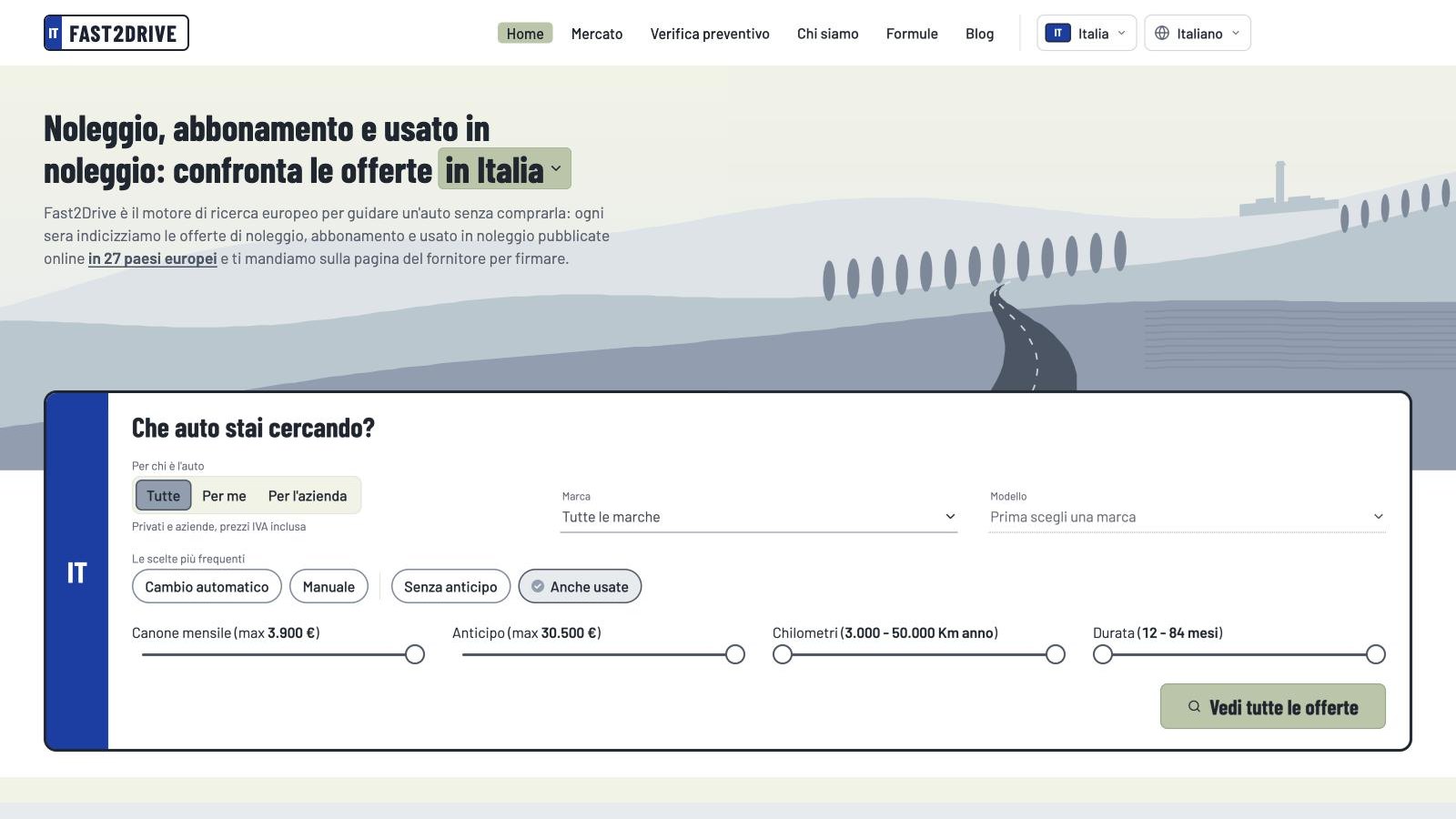
At Interlogica we like to try things before we talk about them. So, at the beginning of November, we decided to run an experiment on ourselves: take one of our products, Fast2Drive, and rebuild it with a single human being and a team of artificial intelligences.
The human being is Alessandro Fossato, founder and CEO of Interlogica. The artificial intelligence chats number thirteen.
A product to switch back on
Fast2Drive was born in 2017 as an Italian comparison site for long-term car rental. For a few years we left it as it was: the site worked, the offers came in, but the product wasn’t growing. The technology was ageing, and meanwhile the market was changing, becoming more and more European and made of more and more formulas: rental with services, monthly subscriptions, flexible formulas.
On the evening of 3 November Alessandro opens a chat with an artificial intelligence and writes a simple sentence: “In this chat we talk about rebuilding the Fast2Drive service”. It is day one.
The next day, instead of updating the old site, he decides to rewrite it from scratch with modern technologies. Within twenty-four hours the new version is running on his computer. Two days later there is a complete test environment, next to the real site, where we can experiment without touching what users see.
From one country to twenty-seven
On 7 November the first thing happens that, looking back today, feels like a small symbol. The new site has a country selector that stays hidden as long as offers come from a single country, Italy. The next day the Netherlands, France and Spain arrive, and the selector appears on its own: nobody touched the code, the data arrived.
From there, growth is quick. On 9 November the United Kingdom joins, on the 11th the site covers 20 countries, on 13 November 27. The sources we collect offers from go from 11 to more than 190. Every evening we index the rental, subscription and used-car rental offers published online in Europe, and we send users to the provider’s page to sign.
The name of what we are building changes too. Fast2Drive stops presenting itself as an Italian comparison site and becomes the European index for driving without buying. With a new visual identity: a logo shaped like a number plate, with the country code.
The team: thirteen chats, each with a job
At first there are only a few chats, and Alessandro coordinates them by hand. Then, day after day, each one specialises and the team takes the shape of a company. One rewrites the platform, one collects the offers, one looks for rental websites country by country, one designs the pages, one checks data quality, one analyses the market, one prepares the communication.
On 10 November a supervisor is born: a chat that receives Alessandro’s requests and dispatches them to the others. On the 14th come an engineer, who checks code quality and brings order to the processes, and a storyteller, who keeps the project’s timeline: the same timeline that lets us write this article.
On the evening of 15 November Alessandro decides that two more roles are needed, one for legal matters and one for relations with industry operators. Seven minutes pass between his yes and the new chat’s first deliverables. Bringing a person into a team takes weeks, and rightly so; a new skill entrusted to a chat is up and running in minutes.
Alessandro does not really work alone: some Interlogica colleagues step in on specific tasks, and a lawyer looks after the matters that need professional advice. But the daily work, from design to code to checks, is done by the AIs.
The work becomes deciding
So far the team has produced about 95,000 lines of code. Alessandro has not written a single one.
That does not mean he put little into it. For three weeks Fast2Drive took twelve, fourteen hours a day of his time, and he lived them as passion rather than work: the first requests go out before six in the morning, the last decisions come after eleven at night. His role is a different one: setting the direction, choosing, saying no. The chats propose, he decides. And when the chats become many, he becomes the bottleneck. On 16 November he says so frankly: following the conversation with all the chats, keeping each one’s context in mind, is hard for a human being. The answer is not to slow the machines down but to reorganise the work around the human limit: from that day on, no chat asks him questions directly. Decisions go through the supervisor and reach him as self-explanatory cards that he can answer with a tap on his phone.
The phone, precisely. On the morning of 17 November Alessandro is out of the office, between journeys and meetings, working in the gaps. In 33 minutes, with six chats in parallel, a new admin panel is built. In 35 minutes the whole site changes its colour palette. A bug in the filters, spotted on the phone screen, is fixed in 38 minutes.
It has not become easy
Put like that, it sounds like a story in which the human watches and the machines work. That is not how it went.
The AIs write the code, but they do not know what to build, in what order, with what risks and to what minimum quality. That remains human work, and it takes experience. Not a programmer’s experience: the experience of someone who has led complex software projects for years.
It is the experience that, from the very first days, insists on a test environment separate from the one users see, because a stable and secure system is not built by trying things out on the live site. It is the experience that, faced with a wrong figure on a small car, sets up a dedicated quality check, so that the same error does not repeat across thousands of offers. It is the experience that, when the chats become many, asks for an engineer to set the standards, review the code, measure how efficient the pages are and keep track of every process. These are the quality gates of any good project: the AIs respect them, but someone has to know they are needed and insist on them.
Then there is the market. Understanding that a 48-month subscription is a long-term rental, because what counts is the contract, not the name. Taking a promise like “at the lowest price” off the home page until it is proven. Deciding every day what to do now, what to postpone and what to say no to. These are choices no chat can make on behalf of someone who knows the industry and has a clear idea of where they want to take the product.
AIs get confused too
It would be easy to tell only the successes. But the experiment is interesting precisely because it also shows the problems of a real company.
With so many working together, the same rules had ended up written in several places, sometimes differently. The definition of a “valid offer”, for example, existed in six versions. It is the classic confusion between departments of a company that grows fast. On 18 November the engineer reviewed the code, listed fifteen business rules and gave each one a single owner and a single place to live. The map and the decision took a few minutes; the fixes will come in stages over the next few weeks. But the review did not happen by chance: someone had to ask for it, knowing that in every fast-growing project it happens sooner or later.
Then there is honesty about data. An offer with the wrong mileage on a small car taught us to check that information is correct, not just how much of it there is. And when a comparison between two countries seemed to offer an eye-catching headline, the team found out it was comparing different products. It gave up the headline and built a more useful figure instead: what the monthly fee really includes.
23 November, and after
The new www.fast2drive.com goes live on Monday 23 November. It is the first milestone, not the last: after the launch will come services for industry operators, and new languages and countries.
But there is a bigger question, about how companies are run. If a European product can be built in three weeks by one person and a team of artificial intelligences, what shape can the company that runs it take?
We don’t have the answer yet. But we have learned one thing: AI has not made building a platform trivial. It has taken away almost all the time spent on execution and put everything else at the centre: project management skills, knowledge of the market, the ability to make decisions every day, a clear business vision. The difference between a platform that works and one that doesn’t is made by those who know what to ask for, and why.
We don’t know how far the experiment will go; we know we want to tell it as it happens.
Fast2Drive is one of our products: from 23 November you’ll find it at www.fast2drive.com.
Translated in November 2026 from the Italian original.