
Smart working: pros and cons. Interlogica's report
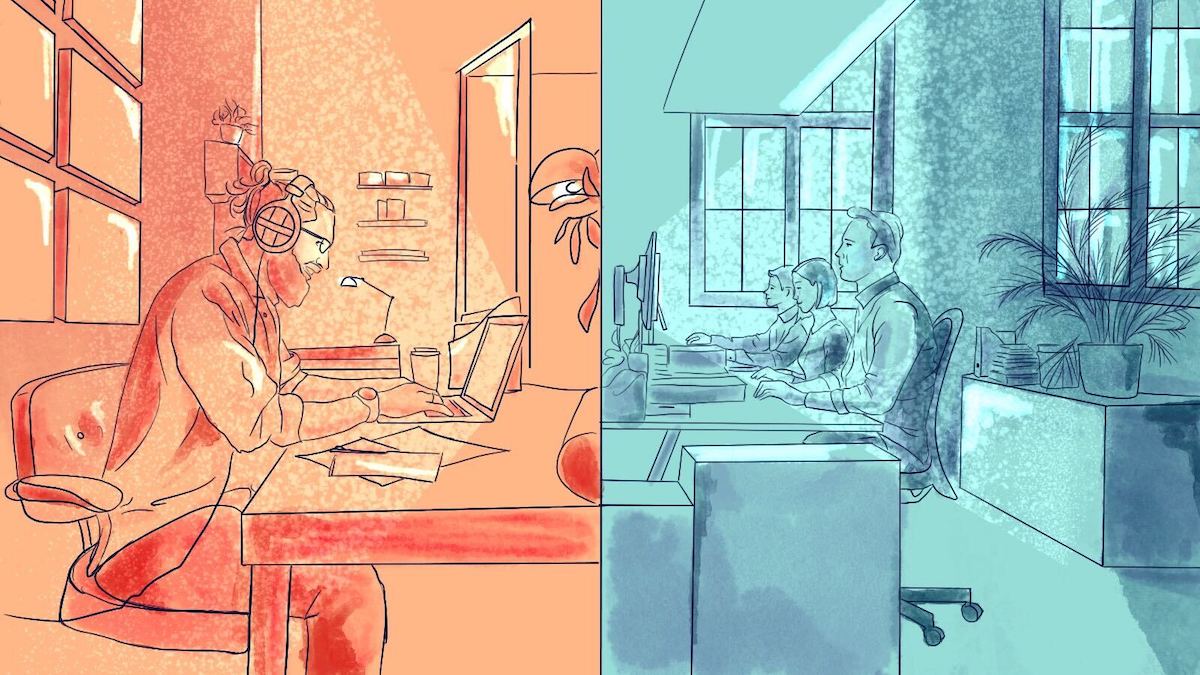
Each of us has lived through this period of global uncertainty with a different sensitivity: it required adapting quickly to new rules, written and unwritten, and forced a series of changes that will stay with us for a long time.
Now the offices are open and, albeit with some restrictions, available to us again. At the same time, after the “forced” test phase, the idea of smart work as a system, and as a way of working that can really be put into practice, is starting to take a defined shape and to become clearer.
How do the people who worked remotely during this long period feel about it?
And what role will the office play in our future?
We want to answer with an internal survey: a report made of many questions and as many answers, made of percentages that sum up different kinds of situations, made of opinions expressed freely, revelations, people.
During the lockdown many of us had already had the chance to give a very personal view of how they were facing the rapid switch from office to home office, and the result was an intimate snapshot of Interlogica.
This time, thanks to interviews carried out by our People Team, the result is a varied overview of the PROS and CONS of remote work. Yes, because the coin does not only have a bright side. We are complex people and, as such, we live situations in a complex way, with a thousand different shades.
What is the report for? Many things. First of all, it let us give an honest opinion, bringing to the surface both the positive aspects (the truth is that we really liked working from home continuously) and the critical ones, because all that glitters is not gold. It also helped us turn what could have been guesses into real data, into genuine field research carried out through a substantial set of questions to the whole company.
We told ourselves that our data could help draw some conclusions, not only about the way we experienced remote work, but also as a useful tool to find solutions better suited to working remotely. It is also interesting to discover how Interlogica’s experience fits like a piece of a puzzle into the wider context of Italian companies, which report a sentiment about remote work very similar to ours.
Smart working: the positive sides and the critical aspects
When the fateful “everyone home” moment struck, many companies quickly activated a whole set of tools their people needed to move the office to their homes; that is what happened to us, for example: in little more than half a day we reached full-remote status.
According to estimates from a survey by the CGIL trade union, at national level Italy went from the 500,000 remote workers recorded before the Covid emergency to more than 8 million in the weeks of lockdown, an impressive figure. The result is a new awareness for companies and workers: remote working can be done, and it no longer concerns a small percentage of people but millions of Italians. A change that will certainly have to come with new ways of working, with updates to company structures themselves and, last but not least, with new rules.
Coming back to our report, it is easy to see the many positive aspects that remote work brings, saving time and money to the benefit of family routines. Sometimes, though, keeping an office at home creates entanglements that are not always easy to manage and that can lead to problems and stress.
There are several elements, and not only in this study, that give people good reason to hope they can keep a smart approach even after the emergency. Thanks to technology we discover that we can work well at a distance too, without having to check in with each other every minute, finding room both for concentration and for sharing, depending on the need.
Our internal survey highlights some strengths that are shared by other research:
- a better balance of time between work and leisure;
- more concentration thanks to fewer distractions;
- savings in the time, costs, risks and stress of commuting;
- the comfort of home rediscovered.
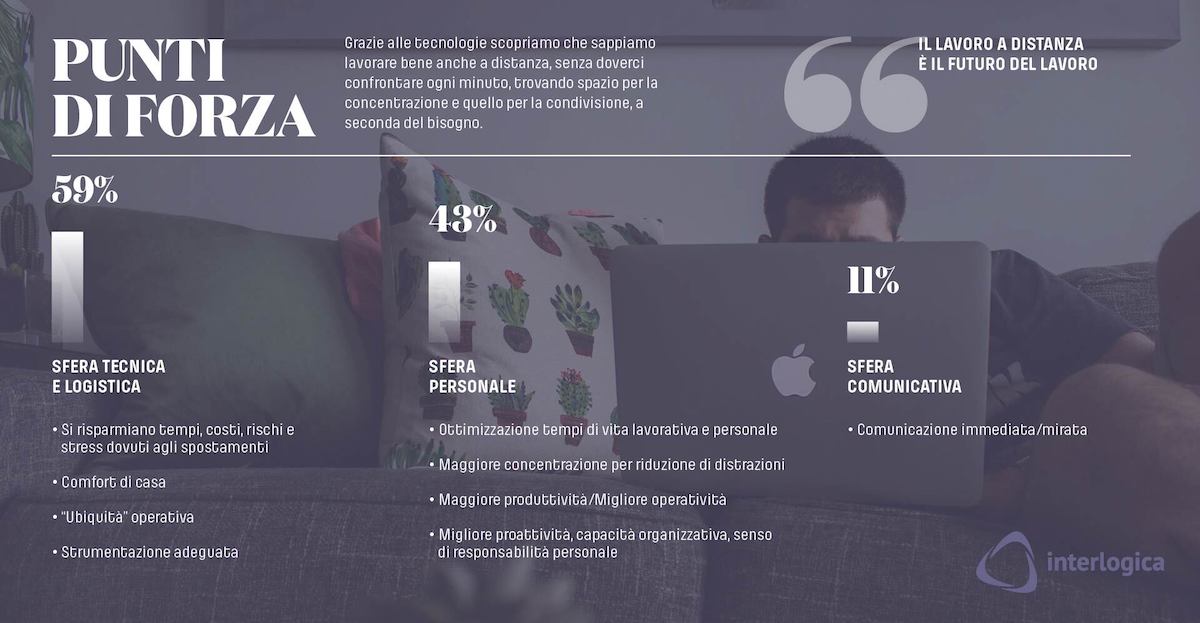
Looking at a wider picture than our own company, it turns out that Italians particularly appreciate the time saved on commuting between home and office, flexible hours and the absence of the distractions typical of the workplace, as well as the chance to manage personal and work needs together.
According to a survey by the Politecnico di Milano (article in Italian), if smart working reached a high level of maturity, the increase in productivity would generate as much as 13.7 billion euros and an individual saving of 135 kg of CO2 a year (with one day a week of remote work): the resulting impact is measured on company costs, on the environment and on productivity.
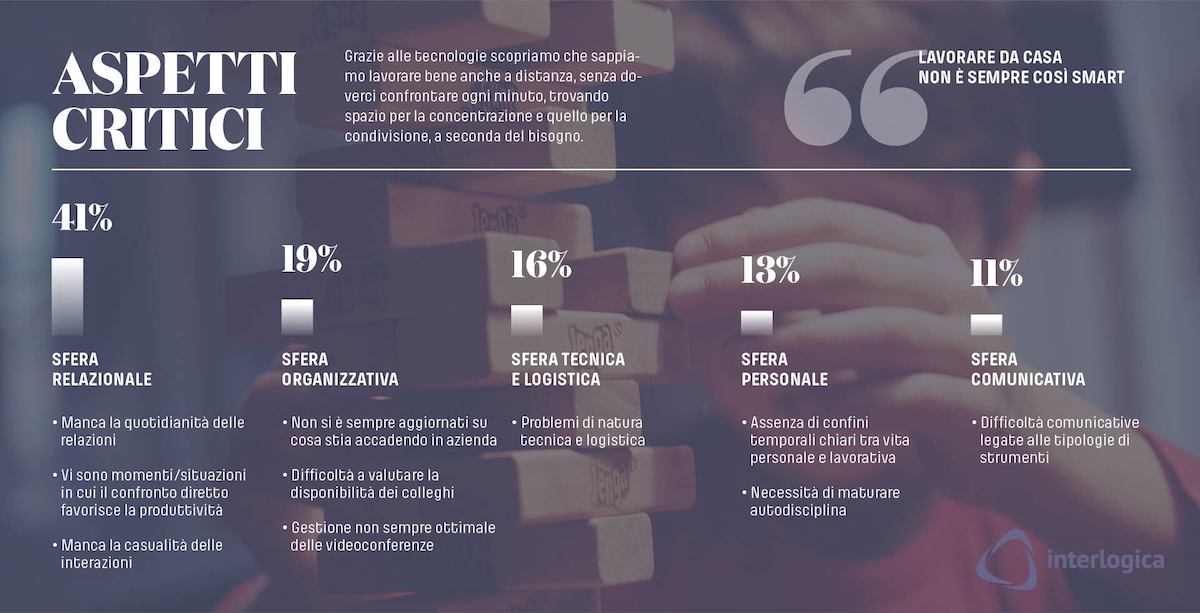
All elements that lead people to appreciate smart work, but there are also other, less positive aspects that make working only remotely a difficult choice.
The lack of social life at work, for example, and daily exchanges with colleagues are two negative findings that amplify the sense of isolation, followed closely by an uncomfortable home workstation and by missing the pleasure of getting ready for the day with an outfit and make-up. Another significant critical point is the little or no attention paid to the right to disconnect.
The greatest difficulties therefore lie in the relational sphere, followed by organisational, personal, communication and technical-logistical ones.
What lies ahead
How it will be possible to resume activities (work and otherwise) from the next phase of the emergency is not known.
However, it is unthinkable that this experience, for many radically different from what they were used to, will leave no legacy and that we can go back to working exactly as we did before 21 February.
The future is uncertain, but one thing is sure: the need for agility and continuous transformation. Qualities that, as an organisation, fit us like a glove.
But that is not the case for everyone. Italy remains, for the most part, a very pragmatic and realistic country, with companies that struggle to talk about a revolution in work or to believe in new and surprising ways of working for tomorrow. The share of workers asking to keep an agile way of working is close to 60%, an actual transition that turns out to be appreciated by managers too.
While the trade unions ask for more regulation, Confindustria believes that this opportunity, if over-regulated, might not deliver the hoped-for results. Moreover, as the same Politecnico di Milano research points out, more than half of Italian small and medium-sized enterprises are not interested in introducing smart work, which makes the Italian challenge even more complicated.
One certainty. At Interlogica we have already looked beyond: after all, this emergency is leading us towards new and surprising transformations, and our report captures exactly this: our desire to experiment, the drive of a company that responds promptly, in an agile and adaptive way.
The pandemic has turned our habits upside down, and this could be reflected not only in the way we will work in future, but also in the spaces where we do it; it could force us to rethink entire urban areas and have repercussions on other aspects of our society, such as education or healthcare.
Some time ago I read that from now on the office should be seen as a platform for content and relationships: a different place, then, from the one we are used to calling an office. An article in the New York Times made the same point: for workers wondering whether they will ever go back to the office, the most honest answer is that even if they do, the office may no longer be the same.
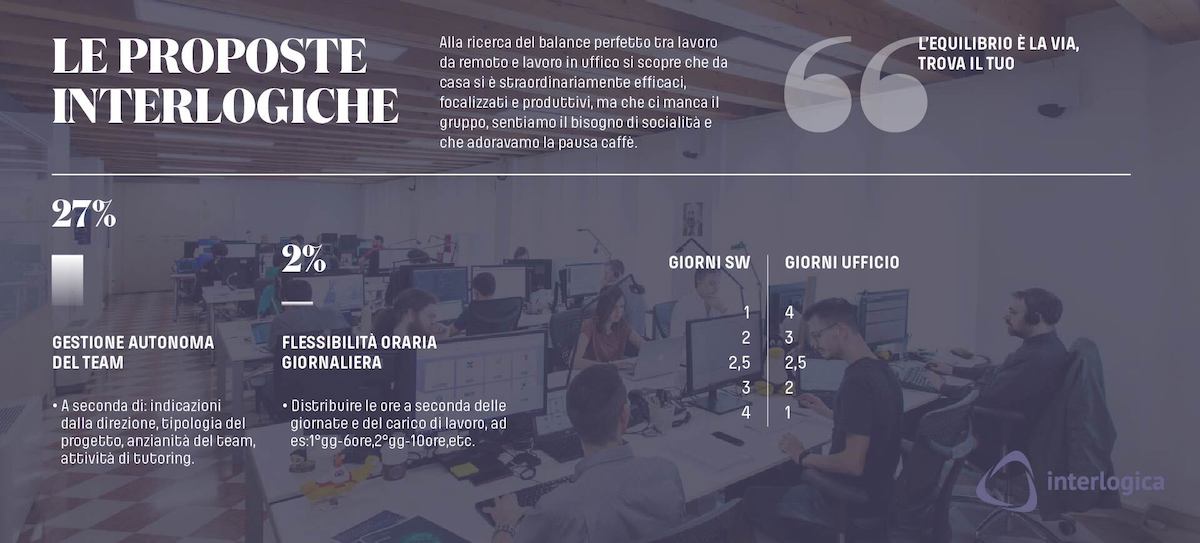
I believe this is exactly the turning point. Having discovered that at home we are extraordinarily effective, focused and productive, we are aware that we miss our colleagues, that we need social contact and that yes, we loved the coffee break, and the office will be our hub of humanity. Work is not a physical place: it is made of people and relationships.
Download the full report (PDF, in Italian)
The charts in this article are in Italian.
Did you like this article? Read also:
Smart Office, the evolution of workplaces and workstyles
Smart Building: 5 growing trends in 2019
Smart Office – when your office is informal and customized
Translated in October 2026 from the Italian original of 15 June 2020.