
Beyond traditional dashboards: AI for business data analysis

At Interlogica we have started a Proof of Concept (PoC) to explore the integration of artificial intelligence and natural language in business data analysis.
The goal is to overcome the limits of traditional dashboards, making access to information more intuitive and immediate.
Thanks to an architecture based on LLMs (Large Language Models), the system lets you query databases in natural language, simplifying how data are managed and interpreted, even for people without advanced technical skills.
Let’s look at it in detail.
Traditional dashboards have always been fundamental tools for business data analysis, but they are often complex to use and require specific technical skills to interpret the information correctly.
This rigidity, together with their pre-packaged structure, can lead to low engagement and resistance from users.
This is where artificial intelligence and natural-language queries come into play.
Dashboards no longer just display data: they become interactive tools that can aggregate information from different sources, simplifying decision-making and improving the overall management of information.
This method is particularly useful in complex contexts – such as performance monitoring, operations management and strategic control – where real-time analysis and intuitive visualisation help spot emerging trends and support quick, informed decisions, making data accessible even to those without advanced technical skills.
Structure of the LLM architecture
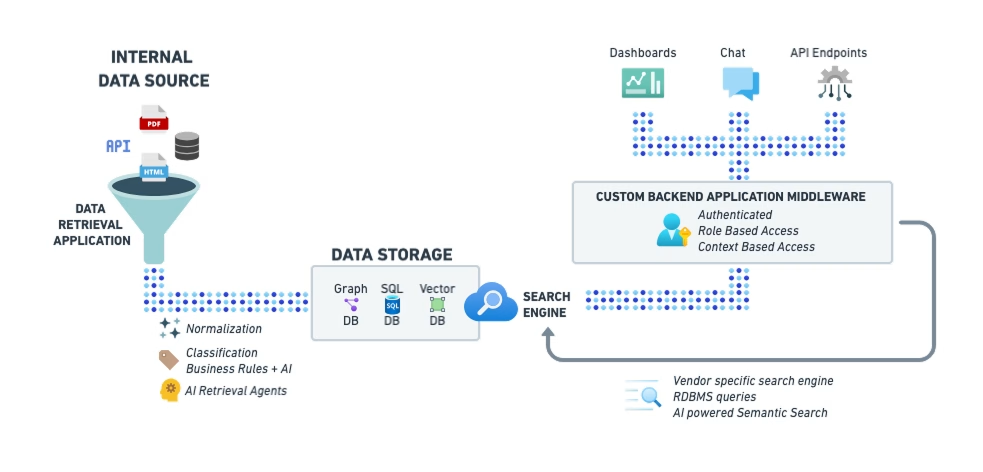
To manage and query data effectively, a well-structured architecture is essential.
A system based on LLMs can handle large volumes of company data in an organised, accessible way.
This translates into an infrastructure that clearly separates the phases of data acquisition and data use, optimising the information retrieval process.
An architecture for generative AI applications has two fundamental parts:
- Data Ingestion: collecting, normalising and classifying data from different company sources.
- Data Retrieval: querying and retrieving information through optimised AI systems.
The infrastructure described includes all the elements needed to enable different AI use cases in a structured company.
1. Data sources (Internal Data Sources)
The data available to the system can come from internal and external sources. We can categorise them as:
- Structured data (e.g. existing databases).
- Unstructured data (e.g. PDF documents, images, text files).
- Semi-structured data (e.g. content extracted from HTML through web scraping).
- Third-party APIs, which provide external data.
2. Data retrieval, normalisation and classification applications

Specific applications and automations have to be built to connect to the available sources and retrieve the data. A layer of normalisation and categorisation is also needed, as well as careful management of data ownership and access security. The phases of this part are:
- AI Retrieval Agents: for connectivity with the data sources and the specific retrieval logic.
- Normalisation: raw data are processed to standardise their format and prepare them for storage.
- Classification with Business Rules + AI: a classification engine enriches and categorises the data according to business rules and AI models.
3. Data Storage
Once processed, the data must be stored in a system that allows them to be searched and used in the future. There are different types of database, each with a specific purpose:
- Vector DB for AI Semantic Search: a vector database for AI search, useful when you want to find information that is similar, for example for searches based on the meaning of words rather than the exact words.
Perfect for AI working with natural language. - Relational database (SQL-based): used for structured data (names, numbers, categories, etc.).
- Graph database: specialised in connected data and relationships between entities.
4. Search Engine

This is the system that finds the right information among all the available data.
It works in different ways:
- Vendor Specific Search Engines: search engines used to search large amounts of text data.
- RDBMS Queries: the classic, SQL-based method, which allows precise searches in structured databases.
- AI-powered Semantic Search: an advanced semantic search system that understands the meaning of words, instead of looking only for exact matches.
The role of AI in querying data
AI can translate text questions into structured queries.
For example, you could ask: “How many employees work at Interlogica?” and the system would automatically translate this request into an appropriate SQL query.
The search engine then interprets the data and gives the user an understandable answer.
This technology is based on Text-to-Query and Query-to-Text processes, allowing a more intuitive and immediate interaction with company databases.
It also integrates with dashboards and chat interfaces, offering context and the ability to drill down into the data displayed.
Towards more intuitive analysis
Looking beyond traditional dashboards means imagining a future in which data are no longer just numbers on a screen, but dynamic tools for understanding and deciding.
The integration of AI and natural language opens up scenarios in which anyone, regardless of technical skills, can talk to company information directly and intuitively.
It is not just about simplifying analysis, but about turning it into a more natural, fluid experience, in which answers emerge as immediately as in a conversation.
In this new paradigm, companies do not just interpret data: they live them, explore them and make them the engine of more aware, responsive strategies.